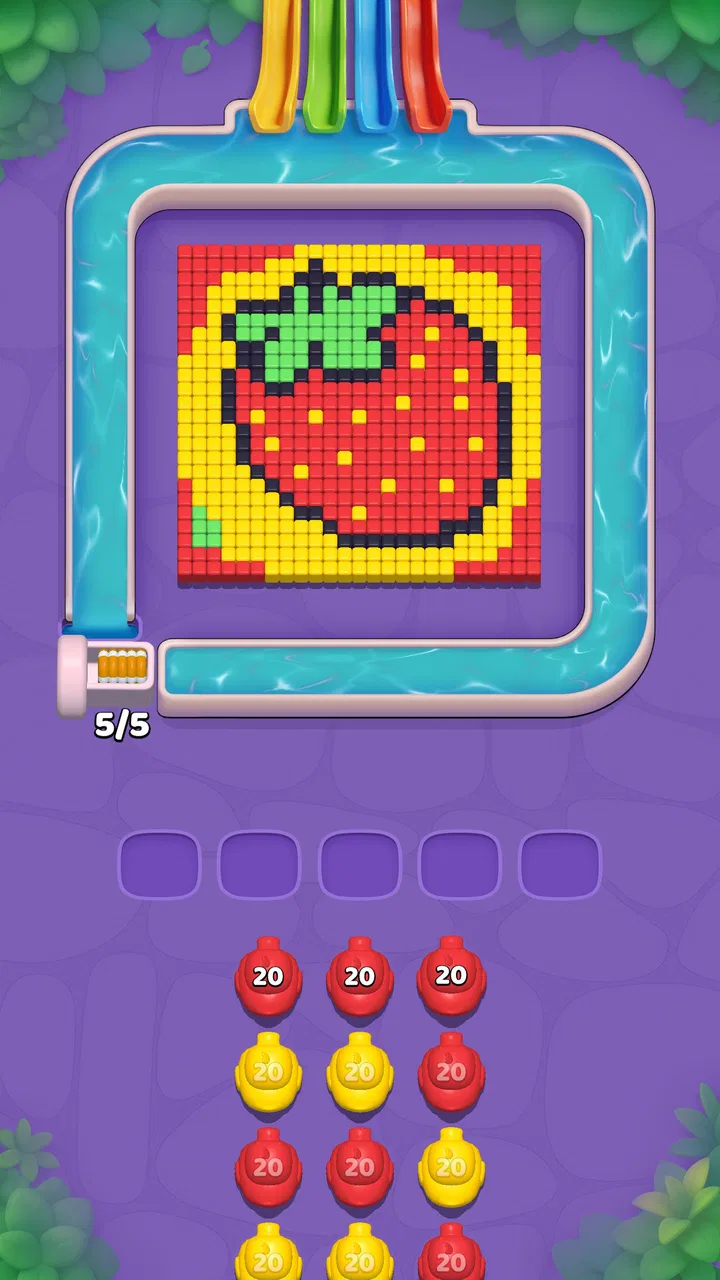
Color Duck Blast
- 4.5
- Rating
- 10.00K
- Installs
- Free
- Price

 Analysis by App-foxy
Color Duck Blast is the kind of board game I reach for when I want a quick, cheerful distraction rather than a demanding strategy session. Its central idea is easy to understand: tap groups of matching colored blocks, make them disappear, and enjoy the little burst of progress that follows. The duck theme gives the familiar blast formula a softer personality, while the simple controls make it approachable from the first minute.
I reviewed it as a casual player who likes puzzle games in short sessions. My overall impression is positive, especially for anyone who enjoys colorful clearing games and does not need a deep story or complicated rules. At the same time, the experience is built around repetition, so its appeal depends heavily on how much you enjoy chasing better board clears and moving through one satisfying setup after another.
How the duck-themed board gameplay feels
The main interaction is wonderfully direct. I look at the board, identify connected blocks of the same color, and tap to remove them. Larger groups are more rewarding to spot because they turn one decision into a bigger clear, while smaller groups help tidy awkward corners. That balance gives each board a small moment of planning without making the game feel like a serious puzzle examination.
You May Also Like

 Pandora - Music & Podcasts
Pandora’s Music Is Easy to Start, but Harder to Recover
Pandora’s strength is its low-effort path from a seed to a station. Its weak spot is how much confidence it asks you to place in connection, setup, and quiet recovery.

 8 Ball Pool
 Is Built on Rivalries, Rematches, and Routine
A close look at the rivalries, rematches, shared routines, and unanswered safety questions that turn a quick pool match into a persistent mobile community.

 Samsung Music
’s Quiet Strength Is Playing What You Already Own
Its reach comes less from spectacle than from dependable access to a personal library. That simplicity is both the app’s strongest retention engine and its ceiling.

 AccuWeather: Weather Radar
AccuWeather Review: A Quick, Clear Forecast for Everyday Decisions
For everyday plans, the best forecast is the one you can understand quickly. AccuWeather makes rain timing, radar, and local conditions easy to act on, with a few trade-offs.

 Hill Climb Racing
Why Hill Climb Racing Still Turns Crashes Into One More Run
A tiny car, a bumpy hill and one more upgrade: Hill Climb Racing keeps resurfacing because its simple chaos makes every near-miss feel personal.

 AliExpress - Shopping App
AliExpress Makes Global Shopping Feel Personal, but Shoppers Bear the Risk
AliExpress turns a global marketplace into a pocket-sized discovery engine. Its reach is useful, its shopping loop compelling, and its trade-offs easy to miss.
More From Our News Desk
View All News


The ducks are more than a name attached to a generic board. They make the presentation feel lighter and more playful, which suits the short-session design. I found the game particularly easy to pick up when I had only a few minutes available. There is no need to learn a complicated control scheme, and the basic action is clear enough that a younger player can understand it quickly.
That simplicity is also the first important trade-off. Players looking for a long campaign with a rich narrative, character development, or a large set of strategic systems will probably find the experience modest. This is a casual board game focused on the pleasure of clearing colorful arrangements, not a replacement for a more demanding tactics game.
Small decisions matter more than fast tapping
Although tapping is easy, I would not recommend treating every available group as equally valuable. A useful habit is to pause briefly before making the first move and scan for the largest connected clusters. Clearing a group can change the shape of the remaining board, so an apparently convenient tap may remove the chance to create a better combination later.
Another practical approach is to work from crowded areas toward isolated blocks. When several colors are packed together, removing the right group can open space and bring matching pieces closer. If I immediately clear every small pair I see, I often leave a less flexible board behind. That is a small but meaningful lesson: the game rewards awareness more than frantic tapping.
This makes it suitable for a relaxed daily routine. I can play during a short break, while waiting for an appointment, or at the end of the day when I want something visually pleasant but not mentally exhausting. A realistic use case is a five-minute pause between tasks: the rules are simple enough to resume instantly, and a session does not require the same commitment as a full card or strategy match.
Progress can be relaxing, but repetition is part of the deal
The satisfying part of this style of game comes from seeing a cluttered board become orderly. I enjoy the rhythm of spotting a group, tapping it, watching the colors collapse, and checking what the next arrangement offers. That loop is easy to understand and gives each move immediate feedback.
However, the same loop can begin to feel repetitive if I play for a long stretch. The game does not seem designed around lengthy continuous sessions in the way a large adventure or competitive title might be. Its strongest use is as a compact diversion. I would rather play several short visits than expect it to carry an entire evening.
This is also where personal preference matters. If you like predictable progress and gentle visual feedback, the straightforward design is a strength. If you need constant novelty, complex objectives, or a strong sense of discovery, the limited core interaction may feel narrow. I would skip it for that reason if my main goal were a deep puzzle challenge rather than a friendly time filler.
Spending, pressure, and the question of fairness
The game is free to download, which makes it easy to try without committing money at the start. It is marked for Everyone, so its presentation is aimed at a broad audience rather than a mature niche. The developer is Zenergy Game, and the title has reached over ten thousand installs with a 4.5 average from more than two hundred ratings. Those figures suggest that it has found an audience, although they should not be treated as a guarantee that its style will suit every player.
There are in-app purchases, with individual items ranging from under one dollar to around one hundred dollars. That is the most important spending detail for a parent or anyone trying to keep a game completely free. I would approach the purchase screen carefully, especially on a shared device, and make sure the device’s purchase protections match the player’s age and habits.
The presence of purchases does not by itself prove that the game is unfair. I did not treat the existence of optional spending as evidence that progress must be bought, and I would not make that claim without direct proof. What I can say is that the broad price range means spending deserves attention. Anyone who wants a strictly no-cost experience should decide that boundary before playing rather than making the decision in the middle of a frustrating board.
For me, the fairest way to approach it is to judge the board first and the purchase prompts second. If I am enjoying the basic clearing loop, I can continue without assuming that every obstacle needs a paid solution. If the game begins to make progress feel uncomfortable without spending, that would be a good point to stop rather than pay automatically. This is a useful rule for any free-to-play puzzle game, but it matters especially here because the game’s simple design can encourage quick, impulsive taps.
Does spending change the competitive picture?
Color Duck Blast is not the sort of title I would choose for serious competition. My enjoyment comes from solving the board in front of me, not from proving that I am better than another player. That distinction makes the spending question easier to frame: the key issue is personal progress and comfort, rather than a tournament ladder or a direct contest where another player’s purchase could decide the result.
I would still avoid assuming that every player experiences progression in exactly the same way. The practical fairness test is simple: can I enjoy the core board-clearing action without feeling pushed into buying something? If yes, the free entry point has real value. If not, players who dislike monetized pressure may prefer a paid puzzle game with a known upfront cost.
There is also a difference between a game being accessible and a game being strategically deep. The low barrier to entry is a benefit, but it means experienced puzzle players may not find enough complexity to justify spending. In my view, purchases make the most sense only for someone who already knows they enjoy this particular loop and wants to support or extend that experience. They are not a sensible first step for deciding whether the game is worth keeping.
What I would check before making a purchase
I would first play enough free sessions to decide whether the colors, pacing, and board decisions remain enjoyable after the initial novelty. I would also read each purchase label carefully instead of tapping through quickly. Since the available items can cost anywhere from $0.99 to $99.99, the difference between a small optional purchase and a major commitment is substantial.
I would then ask myself whether the item solves a temporary annoyance or adds something I genuinely value. Paying because I am impatient is usually a poor reason; paying because I have consistently enjoyed the game and understand what I am receiving is more considered. Parents should make the same distinction with children, since a colorful, easy-to-use game can make accidental purchase attempts more tempting on an unlocked device.
Most importantly, I would not describe the game as pay-to-win. There is no verified competitive system here that would justify that label, and using it would go beyond what I can responsibly conclude. My verdict is narrower: the free version is worth testing, while the wide purchase range calls for sensible spending controls and a deliberate attitude.
Who will enjoy it, and who should choose something else?
I think the best audience is someone who likes match-and-clear or blast-style board games but wants a softer visual identity. The duck theme gives the familiar format a friendly touch, and the controls are uncomplicated enough for casual players. It can also work well for families who want a game that is easy to explain, provided an adult handles purchase settings and expectations.
It is a good fit for short breaks because the main decision is visible immediately. I do not need to remember a complicated inventory, learn a large set of characters, or follow a long plot before the game becomes enjoyable. That makes it less demanding than many mobile alternatives and more convenient when concentration is limited.
On the other hand, I would point a competitive puzzle fan toward a more systems-heavy option. Someone who wants ranked matches, elaborate resource management, or a campaign with a strong narrative may quickly outgrow this format. Likewise, players who dislike free-to-play purchase ranges should consider a premium board game instead, where the cost is settled before play.
It is also not ideal if you want a game that feels completely different from one session to the next. The appeal comes from refining choices within a familiar board-clearing pattern. That can be comforting, but it can also become predictable. I see it as a companion app for spare moments, not as the only game on a device.
Device compatibility and practical expectations
The current version is 1.27.2, and the game supports devices running Android 6.0 or later. That gives it a relatively broad technical starting point for Android users, though the experience can still vary with screen size, performance, and the way a particular device handles visual effects. I would keep the app updated when possible, especially if a board game is used regularly.
The age rating of Everyone reinforces the approachable presentation, but it should not replace adult judgment about spending. A game can be suitable in tone and still require sensible controls around purchases. I would set those controls before handing the device to a child, not after an unexpected tap has already created a problem.
One advantage of the straightforward format is that it does not ask the player to master unusual controls. A touch screen is the natural interface for selecting blocks, and the action is easy to understand. The limitation is that a touch-based board can make mistaken taps feel more frustrating than a deliberate mouse or controller input, so I would slow down when the board becomes crowded.
My trust verdict after weighing the trade-offs
My final view is that Color Duck Blast earns a place as a pleasant, low-commitment puzzle game. I like its approachable board interaction, cozy duck presentation, and ability to fill a short pause without demanding much preparation. The game knows what it wants to be, and that focus is preferable to adding unnecessary systems that would distract from the simple pleasure of clearing blocks.
The main caution is not the core gameplay but the spending context. It is free to start, yet the in-app purchase range extends from $0.99 to $99.99 per item. I would therefore recommend trying the free experience first, enabling purchase safeguards, and treating every optional payment as a conscious decision. That approach lets the player judge the game on its actual strengths instead of feeling obliged to spend.
I also appreciate that the title does not need to be presented as a competitive test to be enjoyable. Its value is in small moments: clearing a troublesome cluster, opening a crowded section, or finding a better move after a previous attempt. Those details are modest, but they are exactly what make a casual board game useful in everyday life.
My recommendation is simple: try it if you want a cheerful blast game for brief sessions, but skip it if you need deep strategy, constant novelty, or a clearly fixed upfront price. For the right player, the free entry point and friendly presentation make it easy to enjoy. For everyone else, a more complex puzzle game or a premium alternative may offer better long-term value.
In short, I see it as an accessible duck-themed board diversion rather than a major gaming commitment. The experience is strongest when I play at its intended pace, make a few thoughtful taps, and stop while the loop still feels satisfying. That balance—enjoying the free core while staying alert to purchase pressure—is the most sensible way to approach it.
FAQs for Color Duck Blast
01What is Color Duck Blast, and how is the gameplay structured?
Color Duck Blast is a casual color-matching puzzle game built around short, easy-to-learn levels. You generally match or combine pieces of the same color to clear objectives, create chain reactions, and earn points. The duck-themed presentation makes the experience feel light and family-friendly, while progressively harder stages introduce more obstacles, limited moves, and special boosters that require a little planning.
02Is Color Duck Blast free to download and play?
Color Duck Blast can typically be downloaded and played without an upfront purchase, making it accessible for casual players. However, free-to-play puzzle games may include optional in-app purchases for coins, extra moves, lives, or boosters. Advertising may also appear between levels or after failed attempts. Before downloading, check the store listing and your device’s purchase settings, especially if children may use the app.
03Does Color Duck Blast require an internet connection?
The basic puzzle gameplay may work without a constant internet connection, which is convenient when traveling or playing in areas with weak signal. Nevertheless, some features can depend on online access, including advertisements, cloud saving, special events, updates, leaderboards, or purchases. If you plan to play offline, download the game and test its main levels first, since availability can vary by version and device.
04Is Color Duck Blast suitable for children?
Color Duck Blast uses colorful visuals, simple controls, and cheerful duck characters, so it may be appealing to children and families. Even so, parents should review the age rating, privacy information, advertising practices, and in-app purchase options before allowing independent play. Puzzle difficulty can also increase quickly, and some children may be encouraged to watch advertisements or request paid items to continue.
05What should I check before installing Color Duck Blast on Android or iOS?
Before installing Color Duck Blast, verify that your phone or tablet meets the current operating-system requirements and has enough free storage for the download and future updates. It is also wise to read recent user reviews, inspect the permissions requested, and confirm whether progress is backed up through an account or cloud service. Downloading from the official Google Play Store or Apple App Store is the safest option.
Pros
- Bright
- cheerful visuals make the game appealing to younger players.
- Simple tap-and-match controls are easy to learn within seconds.
- Short levels fit well into quick gaming sessions.
- Progressive challenges help maintain interest without overwhelming new players.
- Playable offline
- making it convenient during travel or without Wi-Fi.
Cons
- Frequent ads may interrupt gameplay
- especially between levels.
- Later stages can feel repetitive once the core mechanics become familiar.
- Some boosters or extra moves may encourage in-app purchases.
- Difficulty can increase suddenly on certain puzzle levels.
- The game may use noticeable battery power during longer sessions.

Color Duck Blast
Gallery